Fire safety has become an essential part of modern industries, commercial establishments, infrastructure projects, airports, factories, refineries, construction sites and public facilities. As organizations place greater emphasis on workplace safety, emergency preparedness and risk management, professionally trained fire and safety personnel can play an important role in protecting people, property and operations.
For students who want to build a career in this field, choosing the right training institute is an important first step.
If you are searching for the best fire safety institute in India, particularly a professional fire and safety institute in Northeast India, North Eastern Fire Service Academy (NEFSA India) in Dibrugarh, Assam deserves consideration.
NEFSA focuses on professional fire and safety education with a combination of theoretical knowledge, practical drills, emergency-response training and career-oriented skill development.
About North Eastern Fire Service Academy – NEFSA India
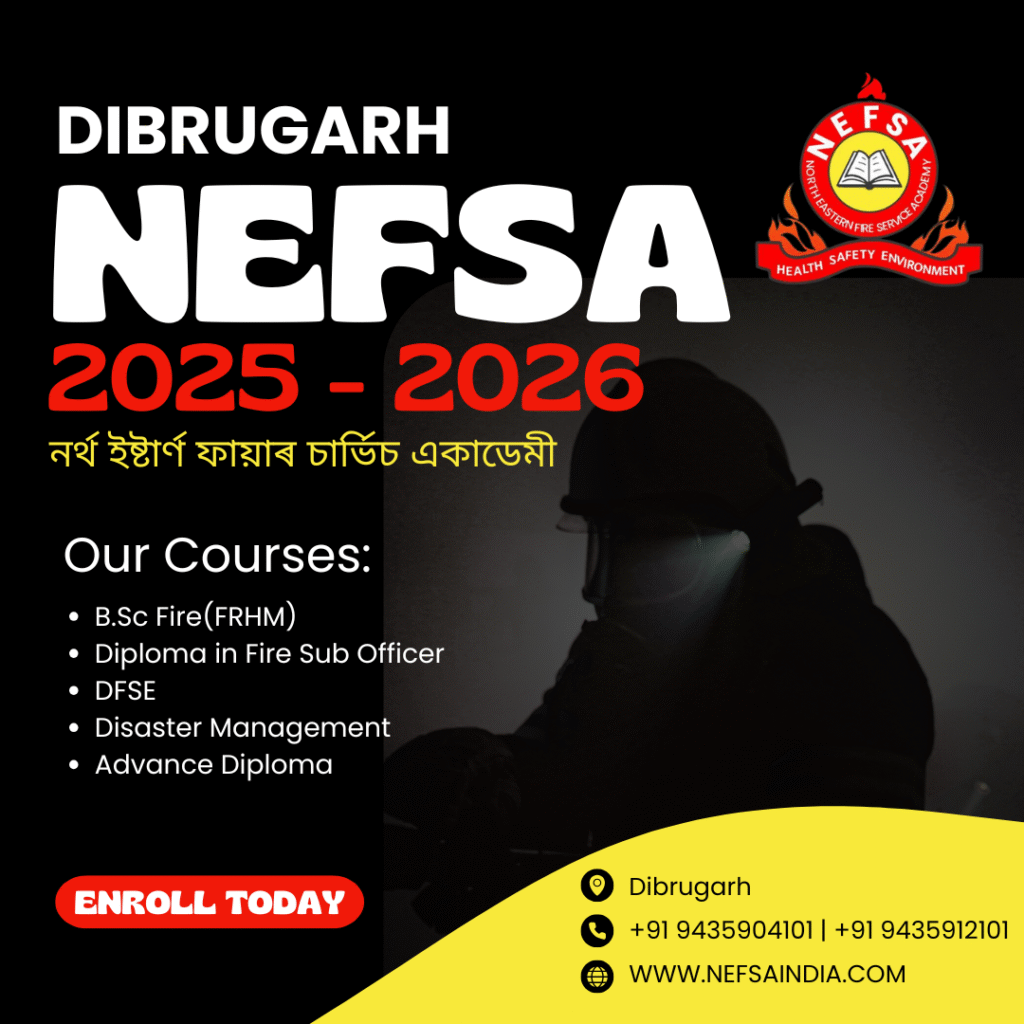
North Eastern Fire Service Academy (NEFSA) is located in Dibrugarh, Assam and works toward developing professionally trained fire and safety personnel.
The Academy states that it was established with the objective of providing professional fire and safety training, particularly to young people from the Northeastern region of India. NEFSA is affiliated with the Government of Assam, Skill, Employment and Entrepreneurship Department.
Its broader objective is to help candidates develop the knowledge, discipline and practical skills required for opportunities across industries, public-sector organizations, government departments and emergency-response environments.
For students from Assam, Arunachal Pradesh, Meghalaya, Nagaland, Manipur, Mizoram, Tripura, Sikkim and other parts of India, NEFSA provides an opportunity to pursue specialized fire and safety education in Northeast India.
Why Fire and Safety Training is Important
Fire and occupational safety involve much more than simply learning how to extinguish a fire.
Professional safety personnel may need to understand fire prevention, hazard identification, emergency evacuation, rescue operations, occupational health and safety, risk assessment, accident prevention and emergency planning.
Organizations such as the National Safety Council of India (NSCI) provide professional training and awareness programmes covering areas including fire and life safety, occupational health and safety, risk assessment and workplace safety.
The Government of India’s National Fire Service College (NFSC), Nagpur, under the Ministry of Home Affairs, also demonstrates the importance of structured education and professional development in fire engineering and fire services.
These initiatives highlight why trained safety professionals are increasingly important for creating safer workplaces and communities.
Why Consider NEFSA India for Fire & Safety Training?
Students searching for a fire safety institute in India should consider several factors before choosing an academy: course structure, practical exposure, instructors, training environment, recognition, career orientation and the opportunity to develop real-world skills.
NEFSA’s programmes are designed around both academic learning and practical fire and safety training.
1. Professional Fire and Safety Education
NEFSA provides specialized programmes covering important areas of fire prevention, firefighting, industrial safety, emergency response and hazard management.
Instead of focusing exclusively on classroom-based education, the Academy’s published course structure includes practical components intended to help students understand how safety principles are applied in real situations.
This makes professional training particularly valuable for candidates who want to enter operational fire and safety careers.
2. Practical Fire Drills and Emergency Training
Fire safety is a practical profession.
A candidate may understand fire theory, but an emergency environment also demands discipline, confidence, teamwork and the ability to follow established procedures.
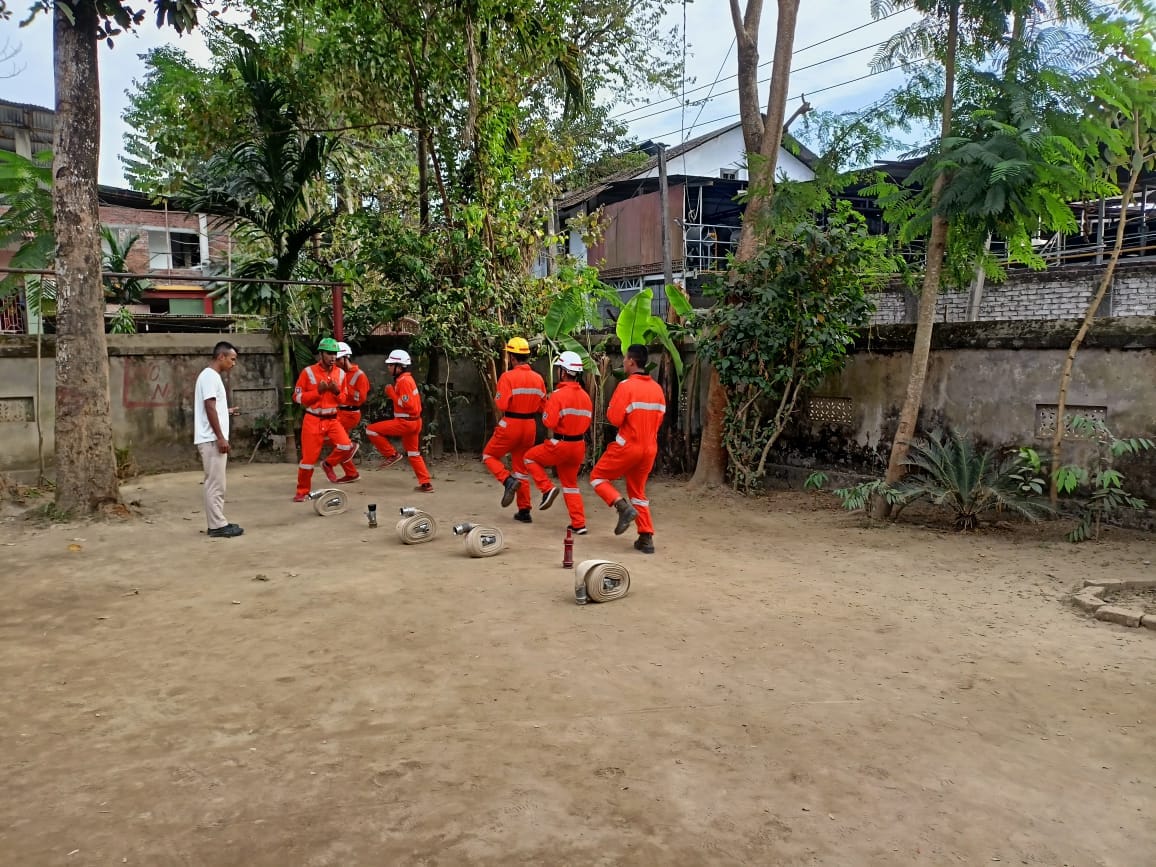
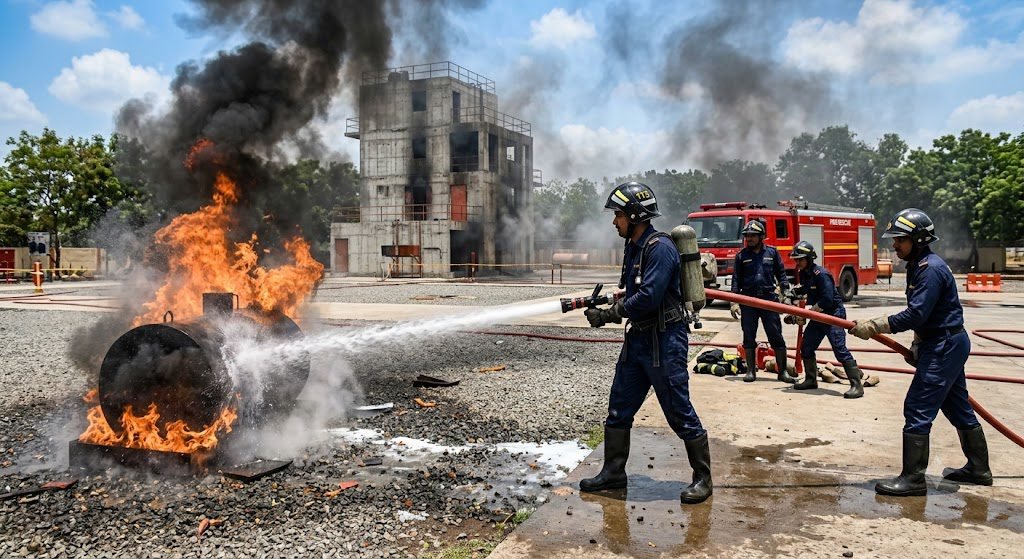
NEFSA states that its courses include practical training, fire drills and real-time simulations.
Depending on the programme, training areas can include:
- Firefighting techniques
- Fire equipment handling
- Hose drills
- Ladder drills
- Rescue operations
- First aid
- CPR
- Evacuation procedures
- Emergency-response exercises
- Fire protection systems
- Disaster-response management
This practical approach helps students connect theoretical concepts with operational situations.
3. Fire Technology & Industrial Safety Management
One of the programmes listed by NEFSA is Fire Technology & Industrial Safety Management.
The programme covers areas such as:
- Fire science and combustion
- Industrial safety management
- Fire protection systems and equipment
- Occupational health and safety
- Risk assessment
- Hazard control
- Disaster management
- Emergency planning
These subjects are relevant to candidates interested in fire prevention, industrial safety and workplace emergency management.
Potential career directions can include positions such as Fire Safety Officer, Industrial Safety Supervisor, Safety Inspector and Emergency Response Officer, depending on the employer’s qualifications, recruitment criteria and experience requirements.
4. Diploma in Fire Sub-Officer
NEFSA also lists a Diploma in Fire Sub-Officer programme.
This programme focuses more strongly on firefighting operations, rescue and emergency-response responsibilities.
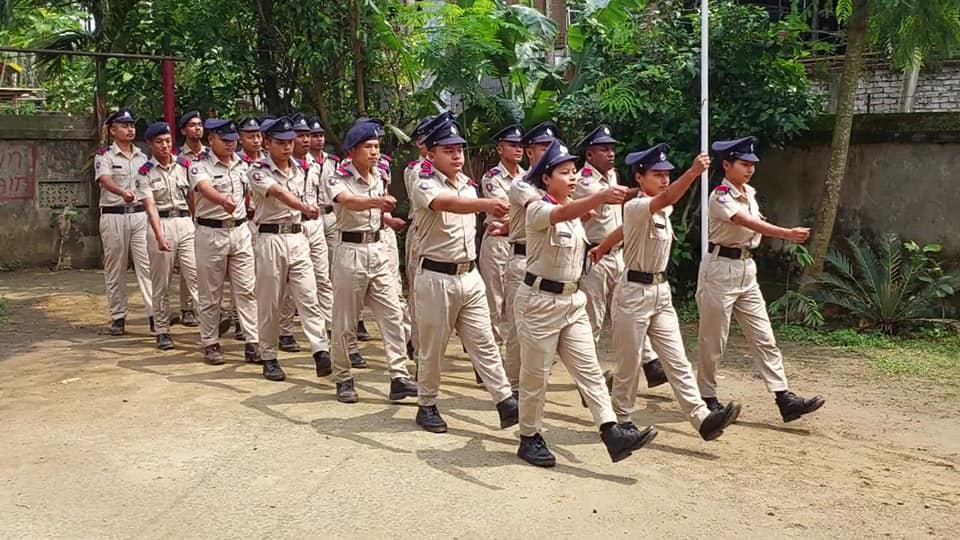
Training areas published by the Academy include firefighting techniques, equipment handling, rescue operations, first aid, fire drills, evacuation procedures, fire-station operations, communication systems and disaster-response management.
Students interested in operational firefighting and supervisory emergency-response careers may find this type of programme particularly relevant.
5. Diploma in Fire Safety Engineering
Another programme available at NEFSA is the Diploma in Fire Safety Engineering.
It focuses on areas including:
- Fire safety engineering and design
- Fire detection and alarm systems
- Safety laws and regulations
- Electrical safety
- Chemical safety
- Accident investigation
- Safety auditing
The programme can be useful for candidates interested in understanding the technical and engineering aspects of fire prevention and safety systems.
Potential career directions can include fire safety engineering, safety auditing, risk assessment and safety consultancy, subject to the qualifications and experience required by individual employers.
6. B.Sc. in Fire Safety & Hazard Management
Students looking for degree-level education can also explore NEFSA’s B.Sc. in Fire Safety & Hazard Management.
According to the Academy’s published course information, the programme includes subjects such as:
- Advanced fire engineering
- Environmental health and safety
- Disaster and hazard management
- Safety management systems
- Industrial safety
- Construction safety
This programme is designed to develop broader knowledge of fire safety, hazard management and workplace safety systems.
7. Focus on Industrial Safety
Industrial workplaces can contain multiple hazards involving machinery, electricity, chemicals, combustible materials, high-temperature operations and complex production processes.
For this reason, modern safety professionals need knowledge that extends beyond firefighting.
NEFSA incorporates subjects such as industrial safety management, occupational health and safety, risk assessment, hazard control, electrical and chemical safety, accident investigation and safety auditing into its programmes.
This wider approach can help candidates prepare for safety-related responsibilities across different industrial environments.
8. Emergency Preparedness and Disaster Management
Emergency professionals must be prepared to respond in an organized manner when incidents occur.
Training in evacuation, rescue, emergency planning, communication and disaster response can therefore be an important component of professional fire and safety education.
NEFSA integrates disaster management and emergency-response topics into its published course structure, helping students understand how coordinated planning and response can reduce risks during emergencies.
9. Career-Oriented Training
One of NEFSA’s stated objectives is to prepare candidates for employment opportunities in industries, Public Sector Undertakings and government departments.
Fire and safety skills may be relevant across sectors such as:
- Oil and gas
- Petroleum and refineries
- Manufacturing
- Construction
- Power and energy
- Airports and aviation facilities
- Warehousing and logistics
- Hotels and commercial properties
- Hospitals
- Infrastructure projects
- Industrial plants
- Emergency-response services
Actual eligibility for any position will depend on the employer, required qualification, experience, recruitment process and applicable regulations.
10. A Fire & Safety Training Option for Northeast India
For many students from Northeast India, travelling to distant parts of the country for specialized professional education can involve considerable cost and logistical challenges.
Having a dedicated fire and safety academy in Dibrugarh, Assam provides another option for candidates who want to pursue professional training closer to home.
NEFSA’s location can be particularly convenient for students from Assam and neighbouring Northeastern states who are exploring careers in firefighting, industrial safety and emergency management.
Skills Students Can Develop Through Fire Safety Education
Professional fire and safety training can help candidates develop a combination of technical and workplace skills, including:
- Fire prevention awareness
- Firefighting procedures
- Emergency-response knowledge
- Rescue techniques
- Hazard identification
- Risk assessment
- Safety inspection
- Fire equipment handling
- Evacuation planning
- First aid awareness
- Occupational safety knowledge
- Teamwork
- Communication
- Discipline
- Leadership
- Emergency decision-making
These skills can be valuable not only for employment but also for developing a professional approach toward workplace and community safety.
Who Can Consider a Career in Fire & Safety?
Fire and safety education can be suitable for students interested in practical, disciplined and responsibility-driven careers.
NEFSA currently lists programmes with different educational eligibility requirements. Some published programmes accept candidates who have passed Class 10, while the B.Sc. programme lists Higher Secondary in the Science stream as its eligibility requirement.
The Academy also states that physical and medical tests are mandatory before admission.
Candidates should always verify the latest eligibility requirements, intake capacity, admission rules and documentation directly with NEFSA before applying.
Career Opportunities After Fire and Safety Training
Depending on education, certification, experience and employer requirements, fire and safety graduates may explore career paths such as:
Fire Safety Officer – Supports fire-prevention measures, inspections and emergency preparedness.
Safety Supervisor – Helps monitor workplace safety procedures and compliance.
Firefighter – Responds to fire incidents, rescue situations and emergencies.
Fire Sub-Officer – May support or supervise firefighting and station operations depending on organizational requirements.
Industrial Safety Officer – Helps identify and control workplace hazards.
EHS Officer – Works with environment, health and safety systems within organizations.
Emergency Response Officer – Supports organizational emergency planning and incident response.
Safety Inspector – Conducts inspections and identifies unsafe conditions.
Safety Auditor – Evaluates workplace safety systems and practices.
Risk Assessment Professional – Helps identify hazards and assess operational risks.
Job titles and eligibility requirements vary significantly between organizations, so completing a course should not be interpreted as a guarantee of employment in any specific position.
NEFSA’s Approach to Building Safety Professionals
An effective fire and safety professional requires more than technical knowledge.
Discipline, responsibility, teamwork, physical preparedness and the ability to remain focused during emergencies are equally important.
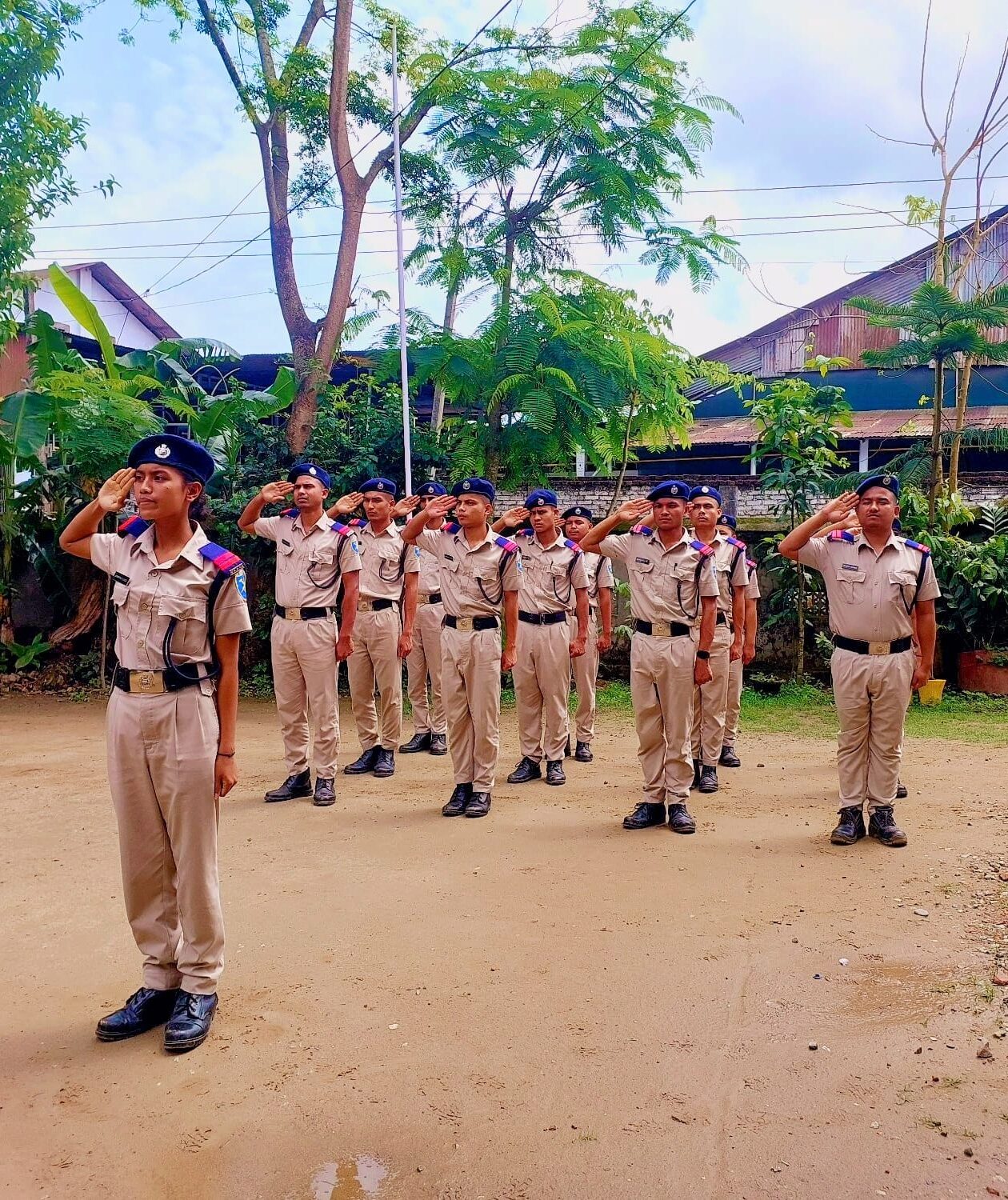
NEFSA emphasizes professional training designed to develop candidates who can contribute to workplace safety and emergency preparedness.
Its focus on students from Northeast India also supports the broader development of skilled safety personnel within the region.
Choosing the Best Fire Safety Institute in India
There is no single institute that will automatically be the “best” choice for every student. The right institute depends on your desired qualification, career path, location, eligibility and training requirements.
Before taking admission, students should compare:
- Course curriculum
- Eligibility criteria
- Recognition and affiliation
- Practical training facilities
- Fire drills and simulations
- Faculty experience
- Physical-training requirements
- Course duration
- Career guidance
- Placement assistance
- Fees and other expenses
- Admission requirements
Students should also verify all current information directly with the institution before paying fees or submitting an application.
For candidates specifically searching for a fire safety institute in Assam, fire safety courses in Northeast India, or professional fire and industrial safety training in Dibrugarh, NEFSA is an institution worth exploring.
Why NEFSA India Can Be a Strong Choice?
NEFSA combines specialized fire and safety education with practical training and a career-oriented approach.
Its key strengths include professional fire and industrial safety programmes, practical drills, emergency-response training, occupational safety subjects, hazard-management education and its location in Dibrugarh, Assam.
For students who want to transform an interest in safety and emergency services into professional skills, NEFSA provides a structured pathway to begin that journey.
Start Your Fire & Safety Career with NEFSA India
Choosing a career in fire and safety means preparing for a profession built around prevention, protection, responsibility and emergency preparedness.
If you are looking for the best fire safety institute in India for your individual career goals, especially if you are searching for a professional fire and safety institute in Northeast India, explore the courses and training opportunities offered by North Eastern Fire Service Academy (NEFSA India), Dibrugarh, Assam.
Before applying, review the latest course eligibility, admission requirements and programme details directly through the Academy.
Learn professionally. Train practically. Build the skills to protect lives and workplaces.