Are you searching for a Diploma in Fire and Industrial Safety in Northeast India (NER) that can help you build a professional career in firefighting, industrial safety, emergency management or workplace accident prevention?
Fire and industrial safety training provides a pathway into occupations focused on protecting people, property and infrastructure. From manufacturing industries and construction sites to hospitals, airports, refineries and commercial buildings, organizations need trained personnel who understand fire prevention, risk assessment and emergency response.
For students from Assam, Arunachal Pradesh, Meghalaya, Nagaland, Manipur, Mizoram, Tripura and Sikkim, professional fire and safety education can open opportunities both within Northeast India and across the country.
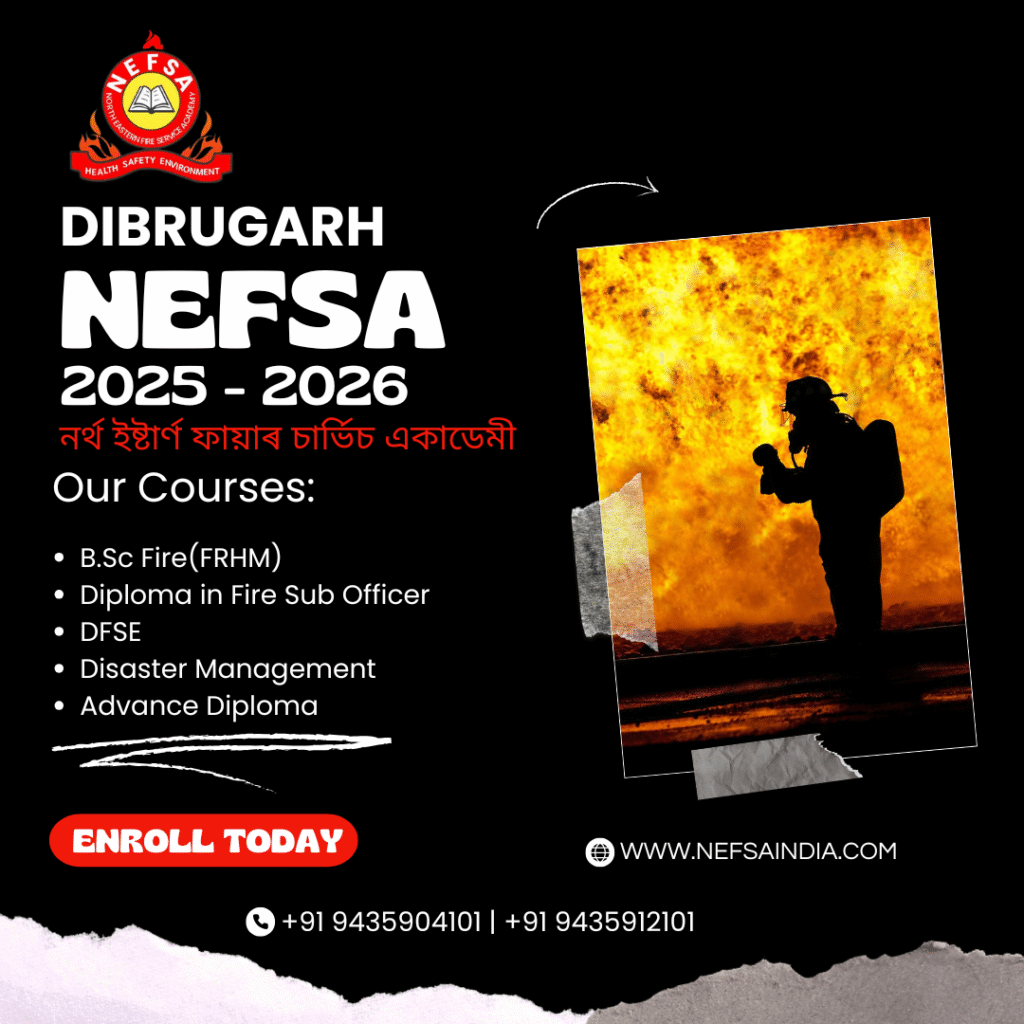
Located in Dibrugarh, Assam, North Eastern Fire Service Academy (NEFSA India) offers fire and safety programs combining classroom learning, practical drills and emergency-response training. Its published courses include Fire Technology & Industrial Safety Management, Diploma in Fire Sub-Officer and Diploma in Fire Safety Engineering.
In this detailed guide, we explain what fire and industrial safety courses involve, who can apply, what students learn and the career opportunities available after training.
1. What is a Diploma in Fire and Industrial Safety?
A Diploma in Fire and Industrial Safety is a vocational or professional qualification intended to build knowledge of fire prevention, industrial hazards, workplace safety procedures, firefighting equipment and emergency response.
The objective is to prepare learners to recognize hazards, implement appropriate precautions, respond to incidents and contribute to safer working environments.
Depending on the institute and awarding body, related programs may carry different titles, durations, entry requirements and qualifications. These can include Fire and Industrial Safety, Fire Safety Engineering, Fire Technology and Industrial Safety Management, or Health, Safety and Environment (HSE).
A relevant national reference is the Directorate General of Training’s Fire Technology and Industrial Safety Management trade, which is a one-year, 1,200-hour training program under the Craftsmen Training Scheme, with Class 10 as its entry qualification. However, this is a specific national trade program and should not be confused with every diploma offered by private or other training institutes.
2. Why Choose Fire and Industrial Safety Training in Northeast India?
Northeast India has a diverse economic landscape that includes energy facilities, construction activities, transport infrastructure, manufacturing, hospitality establishments and public institutions.
Each sector encounters different occupational hazards and emergency preparedness challenges.
Professional fire and industrial safety training can be valuable for students interested in joining:
-
Oil and gas facilities, petroleum-related industries and energy projects
-
Construction and infrastructure companies
-
Manufacturing plants, warehouses and industrial facilities
-
Hospitals, hotels, shopping complexes and other commercial properties
-
Airports, transport facilities and logistics operations
-
Emergency response services and specialized safety teams
Industrial employers may require personnel to participate in safety inspections, emergency drills, preventive maintenance, incident reporting and workplace hazard assessments.
A formal course helps students acquire foundational knowledge for these responsibilities. However, actual job eligibility depends on an employer’s requirements, professional experience, certification and applicable recruitment rules.
3. Fire and Industrial Safety Courses Available at NEFSA India
NEFSA Fire Academy in Dibrugarh provides multiple courses for students interested in fire services and industrial safety careers.
According to its published course information, the following programs are available:
| Course | Published minimum education |
|---|---|
| Fire Technology & Industrial Safety Management | Class 10 pass |
| Diploma in Fire Sub-Officer | Class 10 pass |
| Diploma in Fire Safety Engineering | Class 10 pass |
| B.Sc. in Fire Safety & Hazard Management | Higher Secondary, Science stream |
NEFSA also states that physical and medical tests are mandatory before admission.
Fire Technology & Industrial Safety Management
This program concentrates on important industrial safety subjects, including fire science, combustion, hazard control, workplace safety and emergency planning.
It can provide useful foundations for candidates interested in operational safety, emergency response and fire prevention roles.
Diploma in Fire Sub-Officer
This course focuses on practical firefighting, rescue operations, emergency coordination, fire drills and fire-service activities.
Students study procedures relevant to responding to fires and other emergency situations.
Diploma in Fire Safety Engineering
This program covers fire detection and protection systems, relevant safety regulations, electrical and chemical hazards, accident investigation and safety audits.
It is suitable for students seeking exposure to the technical side of fire protection and safety management.
Important admission note: The exact qualification awarded, program duration, current fees, approving or affiliating body, and employment eligibility for each course should be confirmed directly with NEFSA before applying. A course’s title alone does not establish equivalence to a government technical diploma or eligibility for a particular recruitment examination.
4. Eligibility for Fire and Industrial Safety Courses in Assam
Students often ask whether they can pursue fire safety training after passing Class 10 or Class 12.
NEFSA’s published minimum educational eligibility for its Fire Technology & Industrial Safety Management and two fire-related diploma programs is Class 10 pass. Its B.Sc. in Fire Safety & Hazard Management requires Higher Secondary education in the Science stream.
Candidates should also consider physical fitness, medical requirements and their ability to participate safely in practical exercises.
Admission documents
NEFSA’s admission portal lists documents such as educational records, a recent photograph, signature, identity documents and medical documentation. Some requirements vary according to the applicant’s circumstances.
Students can review the current instructions through the NEFSA Online Admission Portal.
5. What Will Students Learn During Fire and Industrial Safety Training?
A comprehensive fire and industrial safety education should combine conceptual learning with supervised hands-on practice.
Fire science and prevention
Students learn about the principles of combustion, common fire hazards, fire classification, ignition sources and methods of preventing uncontrolled fires.
Understanding how different fires develop is essential to choosing appropriate precautions and equipment.
Fire protection systems
Training introduces equipment and systems used to detect, control or extinguish fires, including alarms, portable extinguishers, hydrants, hoses and other fire protection installations.
Industrial safety management
Industrial safety subjects include identifying workplace hazards, evaluating risks, maintaining safe working procedures and understanding the importance of personal protective equipment (PPE).
Occupational health and safety
Students explore workplace accident prevention, worker protection, safety communication, incident reporting and the fundamentals of health and safety management.
Disaster management and emergency response
Emergency preparedness may involve evacuation planning, emergency communication, rescue fundamentals, first-aid awareness and supervised practical drills.
Fire safety standards and compliance
An important reference for building safety in India is the National Building Code of India 2016 (NBC 2016), published by the Bureau of Indian Standards.
Part 4 addresses Fire and Life Safety, including fire prevention, means of escape and fire protection. The Code is a model standard, with its enforceability depending on its adoption into applicable state and local requirements.
Students can learn more through the Bureau of Indian Standards – National Building Code.
6. Career Opportunities After Fire and Industrial Safety Training
Completing a relevant safety course can help candidates explore entry-level opportunities and build toward more specialized responsibilities.
Fire Safety Officer
Fire safety personnel may assist with preventive inspections, emergency plans, equipment checks, fire drills and reporting.
Officer-level positions may require additional qualifications or relevant work experience.
Industrial Safety Supervisor
Industrial safety supervisors assist in identifying workplace hazards, communicating safety procedures and supporting accident prevention measures.
Firefighter or Fire Services Personnel
Candidates interested in firefighting may pursue recruitment opportunities with eligible fire service organizations, industrial fire teams and emergency response units.
Government fire service appointments require compliance with the particular recruitment rules, including physical standards and recognized qualifications.
HSE Assistant or Executive
Health, Safety and Environment personnel contribute to workplace safety programs, risk assessments, incident documentation and environmental or occupational safety processes.
Emergency Response Personnel
Emergency response professionals help organizations prepare for incidents and undertake assigned duties during emergencies.
Safety Auditor or Safety Consultant
Safety audits and consultancy can become career directions for suitably qualified professionals. Independent auditing and higher-level advisory roles commonly require greater technical competence, experience or additional credentials.
7. Industries Where Fire and Safety Professionals Can Work
Fire and industrial safety knowledge is relevant across many working environments.
In Northeast India, students may explore relevant opportunities in industrial facilities, infrastructure projects, transport organizations, commercial buildings and energy operations.
Professionals can also look for vacancies in other Indian states, particularly where large industrial or infrastructure employers operate.
It is important to distinguish between potential career sectors and confirmed job vacancies. No specific employment offer or guaranteed placement should be assumed merely because a particular industry employs safety professionals.
8. Why Practical Fire Safety Training Matters
Fire and safety careers involve responsibility, decision-making and the application of procedures under potentially hazardous conditions.
Classroom knowledge is important, but students also need supervised training to understand how safety practices work in realistic situations.
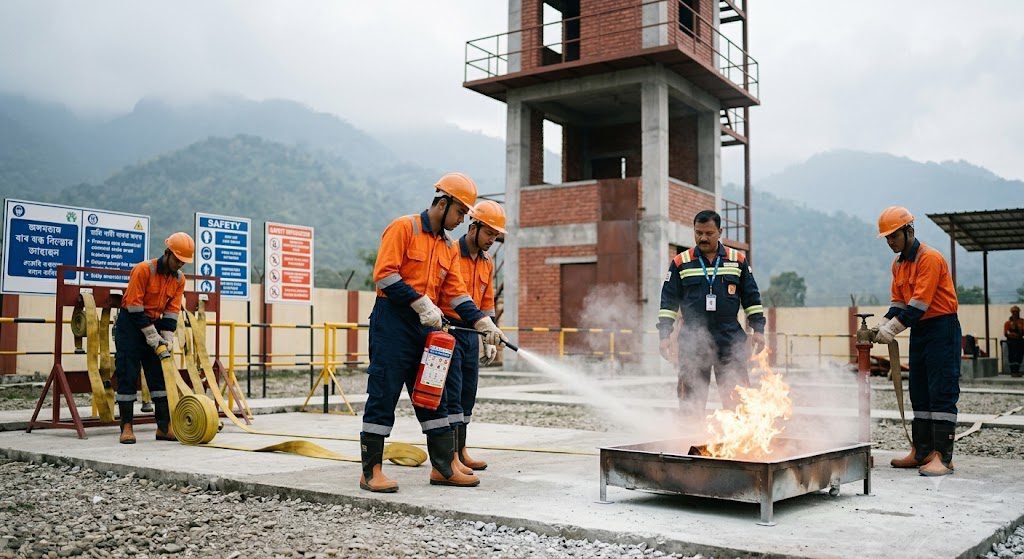
Practical learning can help students develop confidence in equipment familiarization, evacuation coordination, emergency communications, teamwork and hazard recognition.
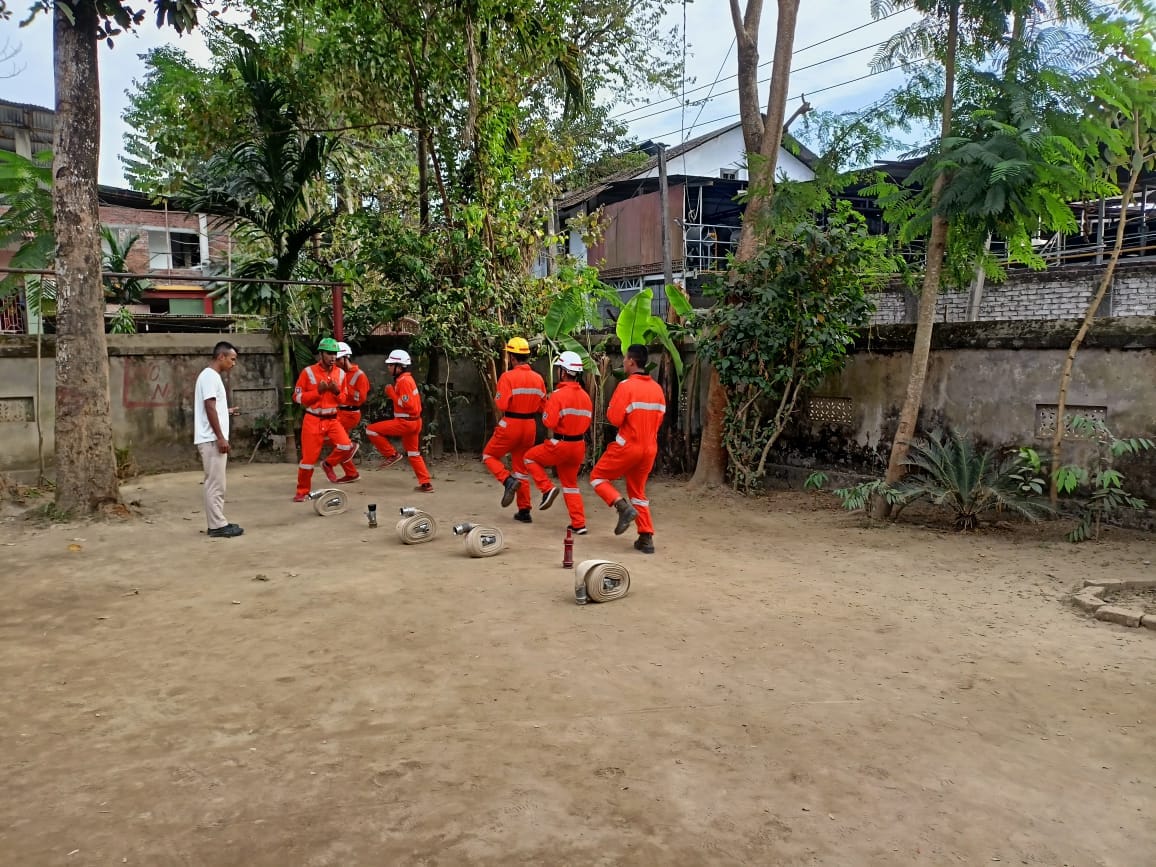
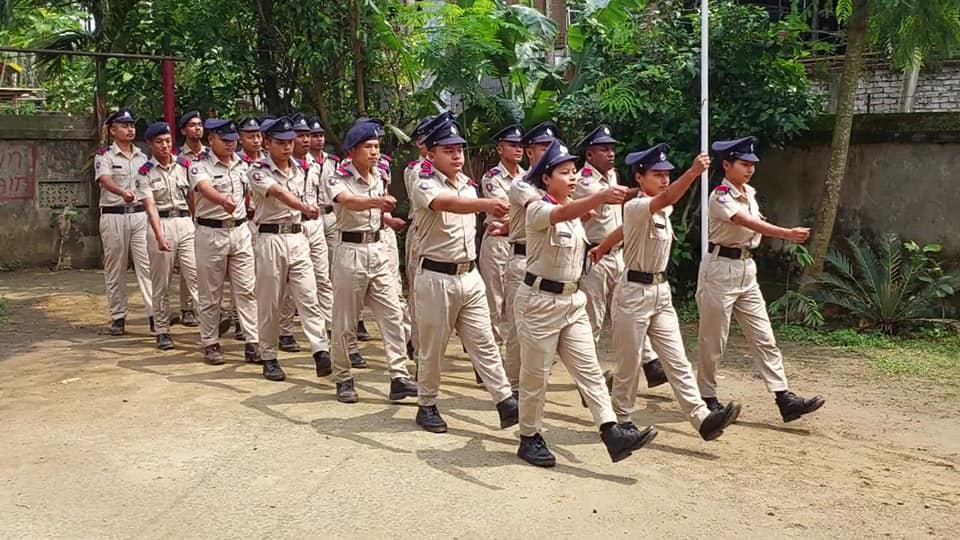
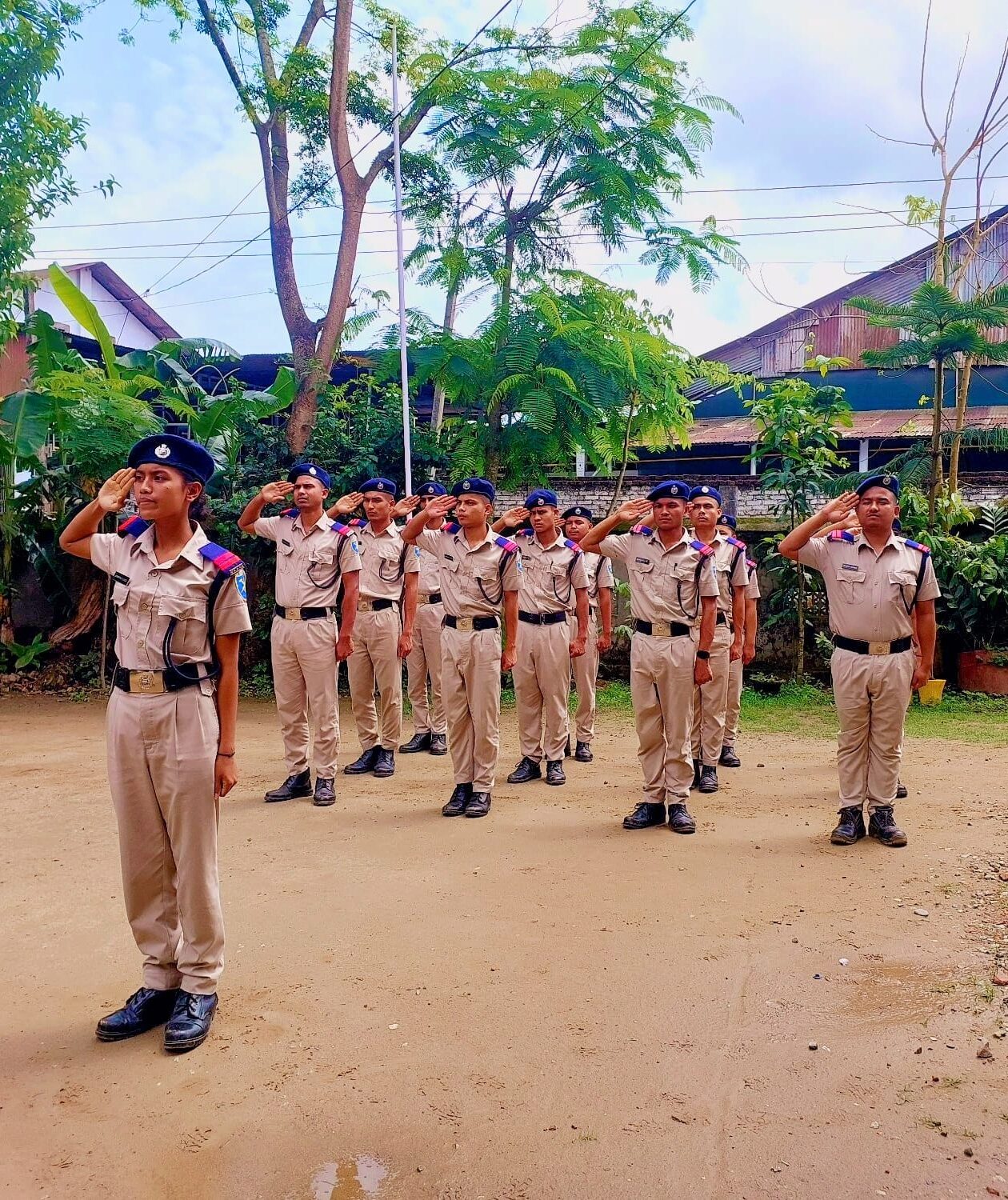
NEFSA describes its training approach as including hands-on firefighting exercises, hose drills, ladder drills, rescue-related activities and emergency simulations.
These are important features to examine when comparing fire safety training institutes.
9. Why Consider NEFSA Fire Academy in Dibrugarh, Assam?
For students searching for fire and industrial safety training in Northeast India, NEFSA offers a regional option without necessarily requiring students to relocate outside the Northeast for their initial education.
The academy emphasizes technical instruction, practical exercises, industrial safety knowledge and career-oriented training.
Its published information identifies a training focus that includes fire prevention, industrial hazard management, emergency response and professional discipline. NEFSA also describes an affiliation with the Government of Assam’s Skill, Employment and Entrepreneurship Department.
Students should request documentation of the specific course’s awarding and recognition arrangements before admission, particularly if their goal is government recruitment or a regulated professional role.
To review available programs, visit NEFSA Fire Academy Courses.
10. How to Apply for Fire and Safety Training at NEFSA
Prospective students can begin by reviewing the courses offered and choosing a program that matches their qualifications and career objectives.
NEFSA provides an online admission portal where applicants can register, provide personal and educational information, upload documents and submit their applications.
The portal also allows applicants to review their applications before final submission.
For the latest admission instructions, visit NEFSA Admissions.
Before making any payment, confirm the current admission schedule, course fees, total training duration, accommodation arrangements (if applicable), refund conditions and certificate details directly with the academy.
11. Frequently Asked Questions
Can I join a fire and industrial safety course after Class 10?
Yes. NEFSA publishes Class 10 as the minimum educational qualification for several fire safety programs, although applicants must also meet its physical and medical admission requirements.
Is fire and industrial safety a good career in Northeast India?
It can be a worthwhile career path for students interested in occupational safety, emergency preparedness and industrial operations. Employment prospects depend on industry recruitment, individual skills, experience and qualifications.
What is the duration of a fire and industrial safety diploma?
There is no single duration for every similarly named diploma in India. As a reference, DGT’s Fire Technology and Industrial Safety Management trade lasts one year, but this does not establish the duration of NEFSA’s diploma programs. Confirm NEFSA’s current duration directly with the admissions office.
Can I get a government job after a fire safety diploma?
A fire safety qualification may be relevant to certain vacancies, but government recruitment depends on the official eligibility rules for the advertised position. Completing a diploma does not guarantee eligibility or selection.
Can fire safety students work outside Northeast India?
Yes, suitably qualified candidates can apply for positions in other parts of India, subject to employer requirements and the recognition of their qualifications.
Does NEFSA provide practical training?
NEFSA states that its programs include practical fire drills and emergency simulations, alongside theoretical instruction.
Conclusion: Begin Your Fire and Industrial Safety Career with the Right Training
A career in fire and industrial safety offers the opportunity to contribute to safer workplaces, better emergency preparedness and the protection of lives and property.
For students considering a Diploma in Fire and Industrial Safety in NER, the most important steps are choosing an appropriate qualification, understanding its eligibility requirements, evaluating practical training and checking its recognition for the intended career.
North Eastern Fire Service Academy (NEFSA India), Dibrugarh, Assam, offers a selection of fire and safety programs for students interested in developing these professional skills.
Explore the available courses, verify the admission details and choose the training path that supports your long-term goals.
NEFSA Fire Academy – Train with Discipline. Learn to Protect. Build a Career in Safety.
Contact NEFSA Fire Academy
Barbaruah NH-37, near Bypass Charali (Zero Point), Dibrugarh, Assam – 786007
Phone: +91 9126485101 / +91 9435904101
Email: info@nefsaindia.com